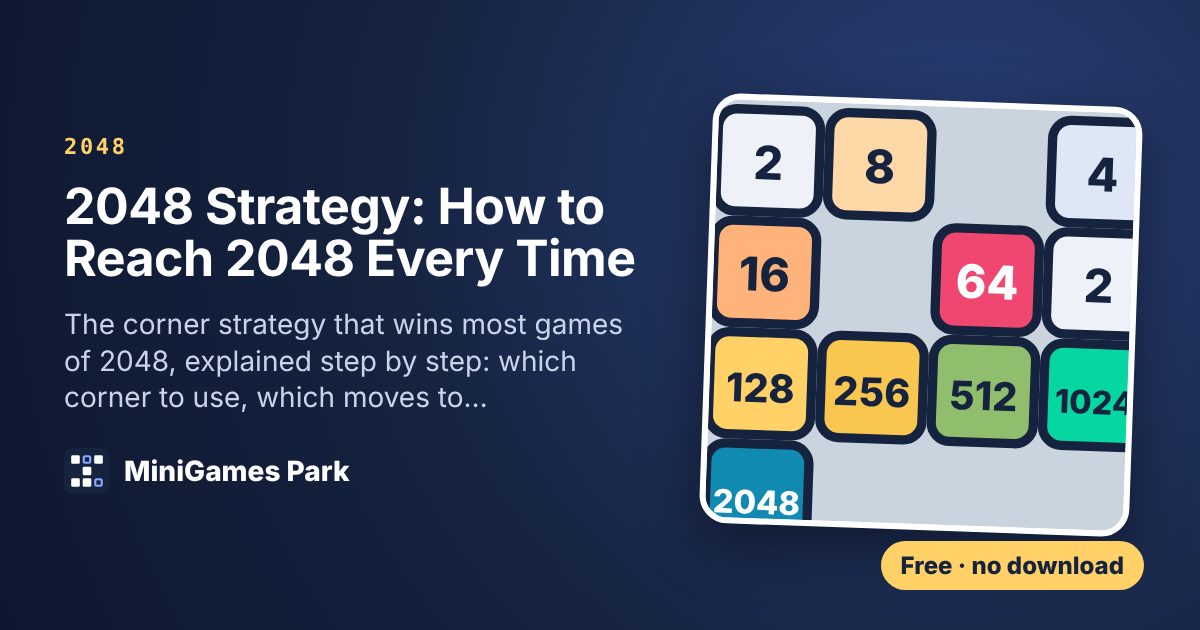
Short answer: Keep your highest tile in one corner (say bottom-left) and never move it out. Mostly press down and left, use right only when you have to, and avoid up. Keep the bottom row full so it cannot slide. Build a chain of tiles that gets smaller as it moves away from the corner (1024, 512, 256, 128), so one merge at the end collapses the whole chain into your corner. Played this way, most games on the classic 4×4 board reach 2048.
2048 looks like a game of luck. A new tile drops into a random empty square after every move, and the board fills up fast. But strong players win nearly every game, because one simple, consistent strategy keeps the board under control. This guide explains it step by step. You can practise each step in our free 2048 game, which has an undo button for your first attempts.
How 2048 works in one minute
You play on a 4×4 grid. Each move slides every tile as far as it can go in one direction. Two tiles with the same number that collide merge into one tile with double the value: 2 + 2 = 4, 4 + 4 = 8, and so on up to 2048. After each move a new tile appears: a 2 nine times out of ten, otherwise a 4. You lose when the board is full and no move can merge anything.
The game was created by Italian developer Gabriele Cirulli, then 19, who built it in a single weekend. It was released on 9 March 2014 and is free and open source. It was inspired by the earlier games 1024 and Threes.
Step 1: choose a corner and commit to it
Pick one corner for your biggest tile. Bottom-left and bottom-right are the most popular, but any corner works. What matters is that you never change it. Every decision from now on is about keeping that tile in its corner.
Step 2: use two main directions, one helper and never the fourth
If your corner is bottom-left:
- Down and left are your main moves. Both push tiles towards the corner.
- Right is your helper, for when down and left do nothing. It is safe as long as the bottom row is full, because a full row cannot slide.
- Up is the move to avoid. It can pull your big tile out of the corner and let a small 2 drop into its place. Press it only if no other move is possible.
Step 3: keep the bottom row full
This is the detail most beginners miss. If the bottom row has a gap, pressing right can slide your corner tile away. Fill the bottom row early and keep it filled. Then your corner tile is locked in place whatever you press except up.
Step 4: build a "snake" of decreasing tiles
Arrange your tiles in order along the bottom row and then back along the row above, getting smaller as they go:
| Column 1 | Column 2 | Column 3 | Column 4 | |
|---|---|---|---|---|
| Row 3 | 8 | 16 | 32 | 64 |
| Row 4 (bottom) | 1024 | 512 | 256 | 128 |
Now watch what happens when you make another 8 next to the 8 in row 3. The 8s merge into 16, which merges with the 16, which makes 32, and so on down the snake into the corner. This chain reaction is how you build 2048 without the board filling up.
Step 5: merge small tiles close to the snake
Small tiles scattered in the top rows are what kill games. Work on the end of your snake, not the far side of the board. If a 2 or 4 appears in a bad spot, merge it into something nearby as soon as you can.
What to do when things go wrong
- Your big tile left the corner. Do not panic. Usually the best fix is to move it straight back with the opposite move before anything fills the corner.
- A 2 dropped into your corner. Build that 2 up quickly so it merges with the tiles next to it, then rebuild the corner.
- Only "up" is possible. Press it, then immediately press down to bring the bottom row back.
- You are stuck with a full board. In our version you can undo up to three moves per game. Use them to escape a bad tile, not to try every move.
Common 2048 mistakes
- Pressing all four directions in a rotation. It feels productive but scatters big tiles around the board.
- Merging big tiles away from the corner. A 256 made in the middle of the board is hard to bring home.
- Playing too fast. 2048 has no timer, so pause before each move once the board is half full.
Beyond 2048: bigger boards and higher tiles
After 2048 you can keep going for 4096 and 8192. The same corner strategy still works, but the snake needs every square, so mistakes cost more. The largest tile possible on a 4×4 board is 131,072, a number computer solvers rarely reach. Our 2048 also has 5×5 and 6×6 boards, where 2048 comes much more easily and scores climb into the tens of thousands, and a 3×3 board that is a real test of skill.
More puzzle games to try
Like merging numbers? Merge Drop is a column-dropping twist on the idea, and Block Garden is a relaxing block puzzle. If you prefer pure logic, our Sudoku has a new daily puzzle, and our Sudoku tips for beginners will get you started. Card players can read how to win at Solitaire.
Questions
What is the best strategy for 2048?
The corner strategy: keep your highest tile in one corner, use mainly two directions that push towards it, keep the row along that corner full, and build a chain of decreasing tiles leading away from it.
Which corner is best in 2048?
None is better than another. Bottom-left and bottom-right are most popular because the game is easier to read that way. What matters is sticking to one corner for the whole game.
Is 2048 luck or skill?
Mostly skill. Tile spawns are random, but a consistent strategy wins most games on the 4×4 board, and computer programs win almost every time.
How many moves does it take to reach 2048?
Usually around 900 to 1,000 moves, since every 2048 is built from roughly 1,000 small tiles, most of them 2s.
Who made 2048?
Gabriele Cirulli, an Italian web developer, released 2048 on 9 March 2014. He built it in a weekend, inspired by the games 1024 and Threes.