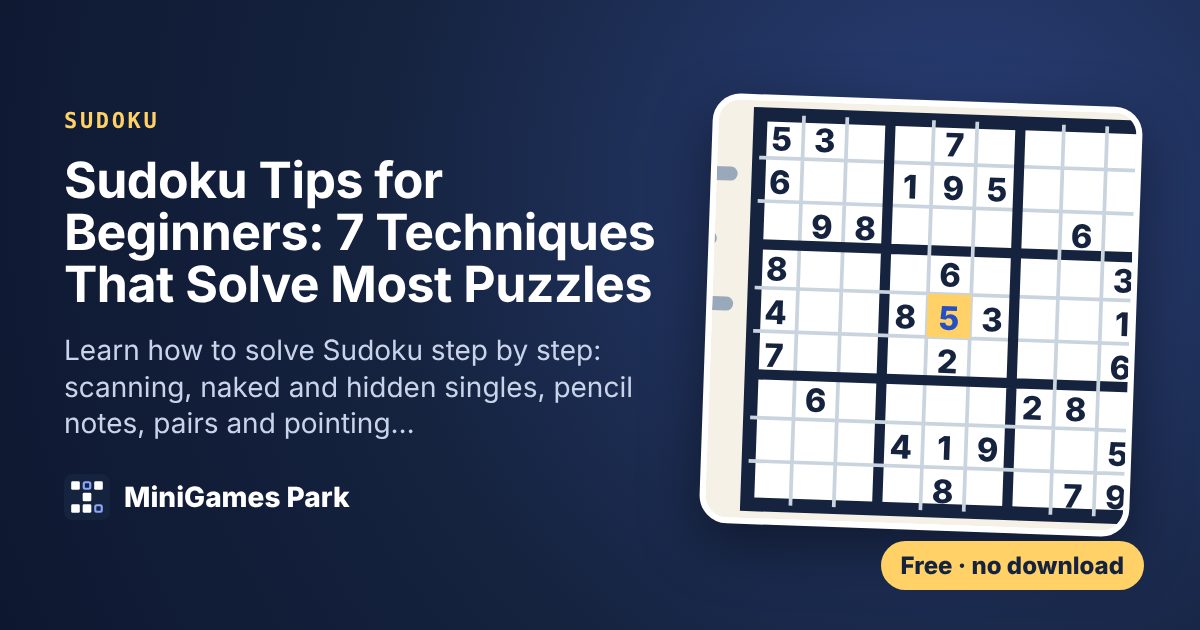
Short answer: Start by scanning: for each digit, check each 3×3 box for the one square where it can still go. Then fill naked singles (a square where only one digit fits) and hidden singles (a digit that fits only one square in a row, column or box). On harder grids, pencil in candidates and look for pairs and pointing digits to eliminate options. Those techniques solve almost every Easy and Medium Sudoku, and most Hard ones. You never need to guess.
Sudoku looks like maths, but it is pure logic. There is no adding up, just the rule that each row, column and 3×3 box holds the digits 1 to 9 exactly once. This guide teaches the seven techniques that do most of the work, in the order you should use them. Try each one as you read in our free online Sudoku, which highlights rows, columns and matching digits to help you see patterns.
The rules in 20 seconds
A Sudoku grid has 81 squares in nine rows, nine columns and nine 3×3 boxes. Some squares start filled in. Fill the rest so every row, every column and every box contains 1, 2, 3, 4, 5, 6, 7, 8 and 9 once each. A well-made puzzle has exactly one solution, and every square can be deduced by logic.
1. Scanning (cross-hatching)
Pick a digit, for example 5. Look at a box that does not have a 5 yet. Every 5 elsewhere in the same rows and columns rules out a line of squares in that box. If only one square is left, the 5 goes there. Work through all nine digits like this, starting with the digit that appears most often. On an Easy grid, scanning alone gets you a long way.
2. Naked singles
Look at one empty square and check its row, column and box. If eight different digits already appear across them, the ninth digit is the only one that fits. Squares in crowded areas of the grid are the best places to look.
3. Hidden singles
Turn it around: pick a row, column or box and a missing digit, and check every empty square in that unit. If the digit can only go in one of them, it goes there, even if that square could hold other digits too. Hidden singles are the most useful technique in Medium puzzles.
4. Pencil notes (candidates)
When scanning stops working, switch on notes and write the possible digits into each empty square. In our game, tap Notes or press N. It sounds slow, but it turns the grid into a picture you can reason about. When you place a correct digit, our Sudoku removes it from the notes in the same row, column and box automatically.
5. Naked pairs
If two squares in the same row, column or box both have only the same two candidates, say 3 and 7, then those two digits must go in those two squares. You can cross 3 and 7 off every other square in that unit. The same idea works for three squares sharing three candidates (a triple).
6. Pointing pairs
Inside one box, if a digit's candidates all sit in the same row, that digit must go in that row within that box. So you can remove it from the rest of that row outside the box. The same applies to columns. This technique unlocks many Hard puzzles.
7. Box-line reduction
The reverse of pointing: if, within a row, a digit can only go in squares that are all in the same box, then it cannot go anywhere else in that box. Remove it from the box's other squares.
How hard is each level?
| Level | Given digits (approx.) | Techniques needed | Typical time |
|---|---|---|---|
| Easy | 40 | Scanning, singles | 5 to 15 minutes |
| Medium | 33 | Hidden singles, some notes | 10 to 25 minutes |
| Hard | 28 | Notes, pairs, pointing | 20 to 40 minutes |
| Expert | 24 | All of the above, triples and patience | 30 minutes or more |
Fewer clues does not always mean harder, but it usually does. Mathematicians have proven that a Sudoku needs at least 17 clues to have a single solution. Gary McGuire's team at University College Dublin showed in 2012 that no 16-clue puzzle works.
Beginner mistakes to avoid
- Guessing. If you are stuck, you have missed a single. Rescan before you guess.
- Forgetting the box rule. Beginners often check rows and columns but forget the 3×3 box.
- Notes that go stale. Update your notes whenever you place a digit, or they will mislead you.
- Fixating on one corner. When an area stalls, move to another part of the grid.
A short history of Sudoku
The modern puzzle first appeared in the United States in 1979 as "Number Place" in Dell puzzle magazines. It is usually credited to Howard Garns, an architect from Indianapolis. In 1984 the Japanese publisher Nikoli began printing it under a name roughly meaning "the numbers must be single", shortened to Sudoku. It became a worldwide craze in the mid-2000s after British newspapers picked it up. There are about 6.67 × 10²¹ possible completed grids, so you will never run out.
Practise every day
The fastest way to improve is little and often. Our Sudoku has a new daily puzzle at Medium level, the same for everyone, with a streak counter. If you enjoy logic grids, try our Daily Nonogram picture puzzle or Minefield. For a different kind of brain workout, read our 2048 strategy guide.
Questions
What is the easiest way to solve a Sudoku?
Scan one digit at a time across the boxes, then look for naked and hidden singles. Those three techniques solve most Easy and Medium puzzles without notes.
Do you ever have to guess in Sudoku?
No. A proper Sudoku has exactly one solution and can always be solved by logic. If you feel you must guess, a single or a pair has been missed.
What is the minimum number of clues in a Sudoku?
Seventeen. In 2012 mathematicians proved by exhaustive computer search that no Sudoku with 16 clues has a unique solution.
Is Sudoku good for your brain?
Sudoku exercises concentration, working memory and logical reasoning, and many people find it relaxing. It is a fun mental workout, though it is not a medical treatment.
How long should a Sudoku take?
A beginner might take 15 minutes on an Easy grid and 30 or more on Medium. With practice, Easy grids take under 5 minutes.