Short answer: In Minesweeper every number tells you how many mines touch that cell, counting all eight neighbours. Reveal every cell that is not a mine to win. Two deductions solve most boards: if a number already has that many flags next to it, its other neighbours are safe; if a number has exactly that many unopened neighbours, they are all mines.
Minesweeper looks like guesswork until you know what the numbers are telling you. After that it is a logic puzzle, and most boards can be cleared without a single guess. This guide uses Minefield, our free minesweeper game, for the examples, and the rules are the same in any version.
The rules
The board is a grid of covered cells. A fixed number of them hide mines. Tap or click a cell to reveal it:
- If it is a mine, the round ends.
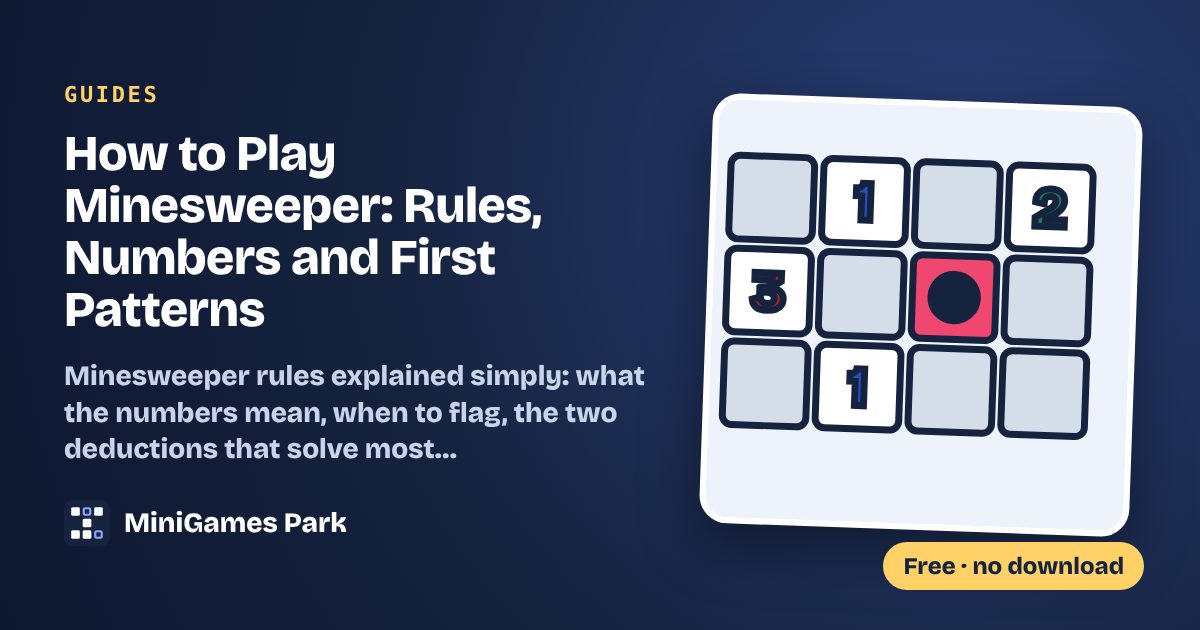
- If it is safe, it shows a number: how many of the eight cells around it hold a mine.
- If that number would be zero, the cell is blank and the cells around it open on their own, which is how large areas clear at once.
You win by revealing every safe cell. You do not have to flag the mines; flags are only a note to yourself.
What the numbers mean
A cell in the middle of the board has eight neighbours: left, right, above, below and the four diagonals. A cell on an edge has five, and a corner has three. A 1 means exactly one of those neighbours is a mine. A 3 means exactly three are.
The number never tells you which neighbour. You work that out by combining it with the numbers next to it.
The two deductions that solve most boards
All mines found. When a number already has that many flags touching it, every other covered neighbour is safe. A 1 with one flag beside it: open the rest.
All neighbours are mines. When the count of covered neighbours equals the number, every one of them is a mine. A 2 with only two covered cells next to it: flag both.
Apply these two over and over. Each flag or opened cell changes what the nearby numbers can tell you, so one deduction usually leads to the next.
Patterns worth memorising
These come up along the straight edge of an opened area, where a row of numbers faces a row of covered cells.
- 1-1 at a wall or corner. When the first 1 can only see two covered cells and the second 1 sees those same two plus a third, the third cell is safe.
- 1-2-1. The mines sit in front of the two 1s. The cell in front of the 2 is safe.
- 1-2-2-1. The mines sit in front of the two 2s. The cells in front of the 1s are safe.
Flagging
In Minefield you flag with a long-press on a phone or a right click on a computer. Flag a cell only when you are sure. A wrong flag is worse than no flag, because the deductions above rely on the flags being correct.
Where to click first
In Minefield your first click is always safe, because the mines are placed after it. Corners and edges have fewer neighbours, which makes their numbers easier to read early on, while a click near the middle is more likely to open a large blank area. Either is a reasonable start.
When you have to guess
Some positions cannot be solved by logic, most often two covered cells in a corner with one mine between them. Before guessing, check the whole board for a deduction you missed. If a guess is the only move left, take it where being wrong costs you the least progress, and take it early rather than at the very end of a long game.
Board sizes
Minefield has three: Easy is 9×9 with 10 mines, Medium is 12×12 with 22 mines and Hard is 16×16 with 40 mines. Start on Easy until the two basic deductions feel automatic, then move up. Your best time for each size is saved in your browser.
Questions
Do the numbers in Minesweeper count diagonals?
Yes. Each number counts mines in all eight surrounding cells, including the four diagonal ones.
Do I need to flag every mine to win?
No. You win when every safe cell is revealed. Flags are optional markers.
Is Minesweeper luck or skill?
Mostly skill. Most of a board is solved by logic, but some layouts leave a position where a guess cannot be avoided.
Can the first click be a mine?
Not in Minefield. The mines are placed after your first click, so it is always safe.