Short answer: In Ludo each player races four tokens around the board and into the centre. You need a 6 to bring a token out of your base, you move clockwise by the number rolled, landing on an opponent sends their token back to base, and you need an exact roll to finish. The first player to get all four tokens home wins.
Ludo is easy to learn and has more decisions in it than it first appears. House rules vary from family to family, so this guide describes the rules used in Ludo Park, our free Ludo game against the computer, and points out where other versions differ.
Setting up
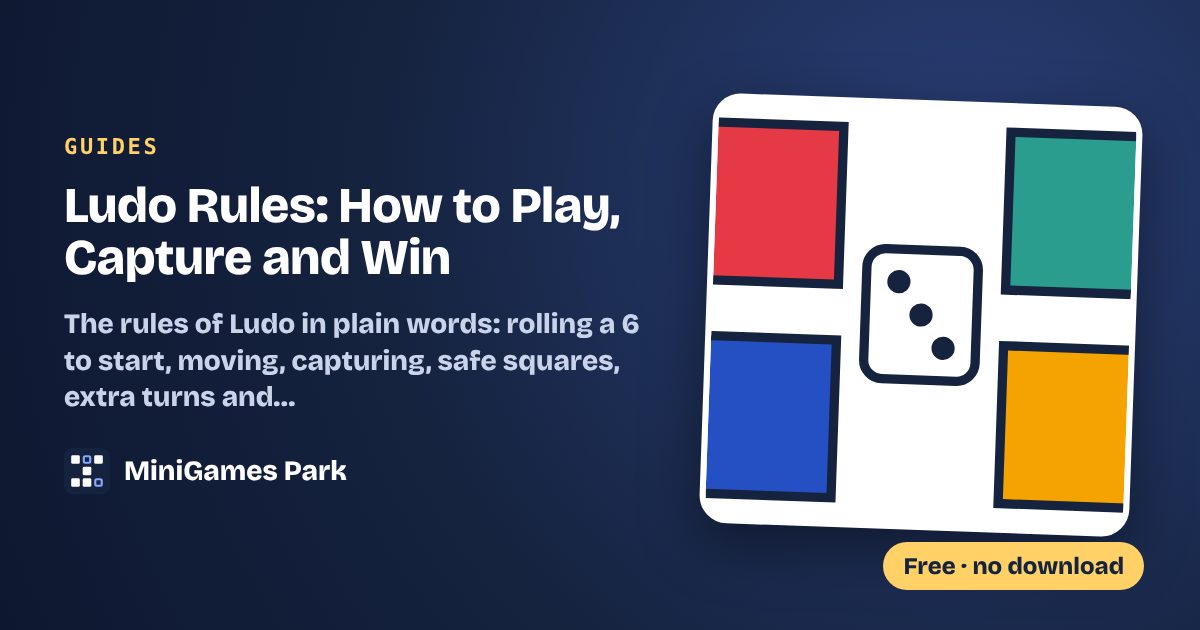
Two to four players each take a colour and four tokens. The tokens start in that colour's base, the large square in the corner. Each colour has its own start square on the outer track and its own home column leading to the centre.
Getting a token out
Roll one die on your turn. You need a 6 to move a token from your base onto your start square. Until you roll one, and while you have no token on the track, you simply pass.
Moving
Tokens travel clockwise around the outer track by the number on the die. If you have more than one token out, you choose which one to move. If only one move is possible you have to take it, even when it is a bad one.
Capturing
Land on a square that holds an opponent's token and that token goes back to its base. Its owner needs another 6 to bring it out again. In Ludo Park a capture also gives you an extra roll.
Safe squares
Squares marked with a star, and every player's coloured start square, are safe. A token standing on one cannot be captured, and tokens of different colours can share it.
Extra turns
- Rolling a 6 gives you another roll.
- Capturing an opponent gives you another roll.
- Moving a token into the centre gives you another roll.
- Rolling three 6s in a row ends your turn straight away.
Getting home
After nearly a full lap, a token turns off the outer track into your home column. Opponents cannot enter it, so a token there is out of danger. To reach the centre you need the exact number. If the roll is too high, that token cannot move.
Winning
The first player with all four tokens in the centre wins.
Strategy tips
- Get two tokens out early. With one token on the board you are forced to move it every turn, including into danger.
- Count six squares behind you. An opponent one to six squares behind your token can capture it with a single roll.
- Rest on safe squares when a rival is close behind, and let them pass.
- Use the home column. When the track is crowded, pushing a token into the column takes it out of reach.
- Take the capture when it is offered. It costs the opponent a full lap and gives you another roll.
Common house rules
Many families play with variations that Ludo Park does not use: two tokens of the same colour forming a block that others cannot pass, needing a capture before you may enter the home column, or bringing out a token on a 1 as well as a 6. Agree on these before a game at the table.
Questions
Do you need a 6 to start in Ludo?
Yes, in the standard rules. A token leaves the base only on a roll of 6.
What happens if you roll three 6s in a row?
Your turn ends straight away. This is the rule in Ludo Park and in most rule sets.
Can two tokens share a square?
On a safe square, yes, including tokens of different colours. On an ordinary square, landing on an opponent captures it.
Do you need an exact roll to finish?
Yes. A token reaches the centre only with the exact number.
Is Ludo the same as Parcheesi?
They are relatives. Both come from the old Indian game Pachisi. Ludo uses one die and simpler rules.